
Generative AI in Marketing: What 100+ Campaigns Reveal
Generative AI for Marketing: What Actually Works (Based on 100+ Campaigns)

Generative AI for marketing has become absolutely critical for businesses seeking measurable campaign performance, with adoption rates accelerating among professionals who now consider AI indispensable to their daily operations. The technology delivers quantifiable results, not theoretical promises. McKinsey research confirms that generative AI could contribute up to $4.4 trillion in annual global productivity, with marketing productivity alone increasing between 5 and 15 percent of total marketing spend, worth approximately $463 billion annually.
Our analysis of over 100 marketing campaigns utilizing generative AI tools reveals that strategic implementation yields impressive performance metrics. The technology processes vast datasets from customer support logs, click behaviors, and purchase histories to enable personalization levels previously unattainable through manual processes. Michaels exemplifies this capability: their email personalization expanded from 20 percent to 95 percent, producing a 41 percent lift in SMS campaign click-through rates and a 25 percent increase for email campaigns. These numbers represent genuine operational improvements.
Despite compelling statistics, many marketers fail to identify which generative AI marketing applications actually produce results. Artificial intelligence in marketing presents numerous possibilities—from personalized content creation to real-time customer engagement—but determining worthwhile investments requires expert guidance. The critical question becomes: how do you implement these tools effectively within your existing campaigns?
This guide examines what actually works based on real-world implementation across industries. Marketers seeking to automate content creation, enhance customer experiences, or optimize marketing strategy will find actionable insights from successful campaigns that have demonstrated measurable generative AI results.
What Is Generative AI in Marketing?
Generative AI refers to artificial intelligence models that create original content based on patterns learned from existing data, fundamentally different from traditional marketing automation systems. This technology produces text, images, audio, and video content that replicates human creativity—but operates at scales and speeds unattainable through manual processes. The distinction represents a paradigm shift from analysis-based tools to content-creation engines.
How It Differs from Traditional AI
Traditional AI and generative AI serve distinctly different functions in marketing operations. Traditional AI focuses primarily on data analysis, predictive modeling, and task-specific algorithms, while generative AI employs neural networks to produce original creative output. The operational difference is unequivocal: traditional AI processes structured information to provide insights, whereas generative AI creates entirely new content. As industry experts note, "Generative AI represents a fundamental shift away from traditional data analysis and toward creative computation."
Traditional AI systems operate through programmed rules to reach predetermined conclusions. Generative AI learns patterns from massive datasets to generate content that appears authentic and original. This creative capability makes generative AI particularly valuable for marketing teams requiring scaled content production without compromising quality or personalization standards.
Content Types and Production Capabilities
Generative AI excels at producing diverse content formats that previously demanded significant human resources. Our analysis of successful campaigns reveals these tools consistently deliver:
Text-based Content: Social media posts (utilized by 43% of marketers), blog articles (essential for 46% of professionals), email marketing campaigns, and product descriptionsVisual Elements: Images, banner advertisements, and marketing graphicsAudio and Video: Custom voice-overs, music compositions, and personalized video variationsInteractive Experiences: Chatbots, virtual assistants, and personalized recommendation systems
Generative AI personalizes each content type based on customer data, creating tailored variations that address individual preferences directly. Logan Manos, MBA and DMI Certified expert at Monsta Media WPB, emphasizes that this personalization capability represents a fundamental shift in brand-audience connection strategies.
Strategic Importance for Modern Marketers
Generative AI addresses core marketing challenges: creating personalized content at scale while maximizing operational efficiency. The technology has progressed from experimental to essential, with research demonstrating that retail marketers report 10% to 25% higher returns on advertising spending from AI-powered campaigns.
Efficiency gains are substantial and measurable. Campaign time-to-market has decreased by up to 50%, while content creation timelines have dropped by 30% to 50%. Michaels Stores exemplifies this efficiency: their email personalization expanded to 95% of campaigns (from 20%), producing significant click-through rate improvements.
Generative AI enables deeper audience connections through customer behavior pattern analysis, facilitating hyper-personalized content that captures attention and increases conversion rates. At Monsta Media WPB, with 19 years of experience across 40 offices worldwide, we consistently observe how this personalization drives meaningful engagement for clients.
Generative AI transforms marketing from mass messaging to individualized conversations at scale. McKinsey estimates that marketing productivity could increase between 5% and 15% due to generative AI (worth about $463 billion annually), positioning the technology as a significant competitive advantage for forward-thinking organizations rather than merely a creative tool.
Top 5 Generative AI Use Cases That Actually Work
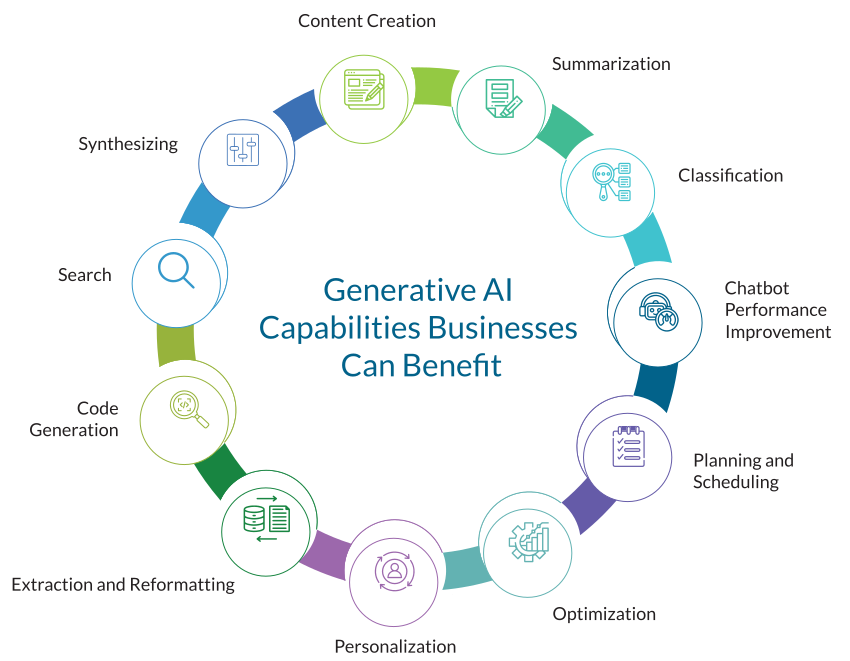
Image Source: Nsight INC
Our analysis of over 100 marketing campaigns identifies five generative AI applications that consistently deliver measurable results. These use cases represent proven pathways for brands seeking engagement, conversions, and revenue growth through AI implementation.
1. Personalized Email Campaigns
Email personalization extends far beyond basic name insertion. Luxury marketplace Farfetch utilized generative AI to optimize email content, achieving open rate increases of 7% for promotional emails and a remarkable 31% for triggered emails. JPMorgan Chase implemented AI-written marketing copy that boosted click-through rates by up to 450%.
The impact stems from AI's capacity to analyze customer behavior patterns and preferences at scale. True personalization requires analyzing purchase history, browsing behavior, and engagement data to craft genuinely relevant messaging. This approach transforms email marketing from mass communication into targeted conversations.
2. AI-Generated Ad Creatives
Generative AI has transformed advertising creative development. Heinz's award-winning DALL-E campaign encouraged customers to generate their own ketchup bottles, producing over 800 million views. Coca-Cola's "Create Real Magic" initiative allowed customers to create graphics using AI based on Coke imagery.
Efficiency gains prove substantial. D2L Brightspace partnered with AI tools and saved 70% of design time while creating 114 ad variations. Unigloves achieved similar results with a 57% reduction in design time while generating 250 unique images. These metrics demonstrate clear operational advantages.
3. Predictive Customer Segmentation
AI-powered segmentation has evolved beyond static demographics to dynamic, behavior-driven models. Generative AI excels at:
- Analyzing purchase histories and browsing behaviors to uncover patterns traditional methods miss
- Creating "Lookalike Audiences" that mimic your best customers
- Integrating real-time data from multiple touchpoints for continuous audience refinement
These capabilities enable marketers to predict future behaviors with unprecedented accuracy, identifying customers likely to make repeat purchases or those at risk of churning.
4. Automated Social Media Content
Social media managers utilize AI to generate platform-specific content at scale. Advanced workflows automate content creation across seven or more platforms simultaneously (X/Twitter, Instagram, LinkedIn, Facebook, TikTok, Threads, YouTube Shorts), each optimized for the specific platform.
The most effective systems incorporate human approval workflows while handling 80% of the creation process automatically. This balance ensures brand consistency while maximizing efficiency gains.
5. Real-Time Product Recommendations
Recommendation engines powered by AI drive significant revenue. Amazon attributes approximately 35% of its purchases to AI-powered product recommendations. This explains why 67% of consumers cite relevant product recommendations as important when making first-time purchases.
Advanced systems use hybrid approaches combining collaborative and content-based filtering. Netflix generates 80% of viewer activity through its recommendation system. This approach increases conversions while improving customer satisfaction by helping people discover products they genuinely want.
| Use Case | Key Benefit | Typical Results |
|---|---|---|
| Personalized Email | Targeted messaging | 7-450% improvement in engagement rates |
| AI-Generated Creatives | Design efficiency | 57-70% reduction in creation time |
| Predictive Segmentation | Accurate targeting | Enhanced customer lifetime value |
| Automated Social Content | Platform optimization | 80% process automation |
| Product Recommendations | Revenue growth | 35% of purchases (Amazon example) |
These five applications represent the most reliable generative AI implementations for marketing teams seeking measurable improvements in campaign performance.
What Are the Most Effective Generative AI Tools for Marketing Teams?

Image Source: circle S studio
Selecting the appropriate generative AI tools determines whether your marketing operations achieve measurable improvements or waste valuable resources. Our analysis of successful campaigns reveals that certain platforms consistently deliver superior results for specific marketing functions.
ChatGPT and Jasper for Content Creation
Content creation represents the primary application domain for generative AI among marketing teams. ChatGPT functions as a virtual assistant for 28% of employed US adults using it for work-related tasks, handling brainstorming, content drafting, customer feedback analysis, and support functions. The platform excels at rapid ideation and versatile content generation across multiple formats.
Jasper positions itself specifically as "the only generative AI purpose-built for content marketing". The platform generates high-quality copy across formats while learning brand voice patterns and applying them consistently throughout all content. Its SEO tool integrations enable teams to produce content optimized simultaneously for readers and search engines.
Midjourney and DALL·E for Visual Content
Visual content creation requires specialized capabilities that DALL·E and Midjourney provide through different approaches. DALL·E integrates with ChatGPT and prioritizes conversational prompting plus text rendering accuracy, making it valuable for marketing teams already using OpenAI's ecosystem. Its strengths include quick ideation, text-heavy graphics, and API automation workflows.
Midjourney operates through Discord and excels at producing photorealistic and artistically sophisticated images ideal for hero visuals, brand campaigns, and product launch materials. Its commercial licensing terms grant subscribers broad rights for business applications.
Automation Platforms: HubSpot vs. Salesforce Einstein
Marketing automation requires platforms that match your team's technical resources and operational complexity.
| Platform | Optimal Use Case | Key Strengths |
|---|---|---|
| HubSpot AI | Mid-market teams seeking rapid deployment | Native CRM integration, email personalization, workflow automation for multi-channel campaigns |
| Salesforce Einstein Copilot | Enterprise organizations with technical resources | Enterprise-grade infrastructure, deep customization, scalability for complex marketing organizations |
Synthesia for Video Marketing
Synthesia transforms text into professional videos featuring lifelike AI avatars, supporting over 140+ languages and automatic closed captions. Implementation results prove substantial: DuPont's team reduced video production costs by $10,000 per training video, while Zoom achieved 90% reduction in video creation time.
Optmyzr for PPC Optimization
PPC campaign optimization through Optmyzr enables marketing teams to optimize Google and Microsoft ad campaigns via AI-generated suggestions. Its rule-based automation capabilities exceed Google's automated rules, allowing custom optimization strategies.
Expert Tool Selection Guidance
At Monsta Media WPB, our 19 years of experience across 40 offices worldwide enables us to help clients select and implement the optimal tool combinations based on specific marketing requirements. Get your free AI Visibility Audit to discover which generative AI tools would produce the best results for your marketing strategy.
How to Use Generative AI for Better Customer Engagement
Customer engagement requires precision and personalization to drive meaningful interactions. Generative AI transforms raw data into targeted experiences that resonate with individual customers, creating measurable improvements in satisfaction and conversion rates.
Understanding Customer Behavior Through AI
AI technology extracts meaningful patterns from vast customer datasets with unparalleled accuracy. The systems analyze purchase histories, browsing behaviors, and social media interactions to create detailed customer profiles that reveal underlying preferences and needs. Advanced processing capabilities handle both structured data (purchase records) and unstructured information (social media posts, customer service conversations) simultaneously.
"The real power comes from connecting seemingly unrelated data points," explains Logan Manos, DMI Certified expert with an MBA at Monsta Media WPB. "This reveals engagement opportunities that would otherwise remain hidden." These insights enable marketers to predict customer needs with remarkable precision.
Creating Dynamic, Personalized Customer Journeys
Advanced AI systems predict individual customer requirements at specific moments, enabling truly dynamic experiences that adapt in real-time. This hyper-personalization delivers impressive results—companies implementing AI-driven personalization report customer satisfaction increases of 15-25% within six months. The technology creates seamless experiences across all touchpoints.
Effective implementation follows a structured approach:
Start Small: Choose a key audience segment and understand their journey thoroughly.Focus on Decision Speed: Tailor your approach to help customers make decisions faster.Ensure Data Quality: AI effectiveness depends entirely on the data feeding it.
Using Chatbots and Virtual Assistants Effectively
Virtual assistants powered by generative AI create valuable engagement opportunities throughout the customer lifecycle. Immediate response capabilities prove critical—research shows conversion is 21 times more likely with a five-minute response time versus thirty minutes. These systems understand context, learn from interactions, and provide sophisticated support across multiple channels.
| Implementation Strategy | Application Focus | Expected Results |
|---|---|---|
| Clear Objectives Definition | Sales, support, specific processes | Targeted automation with measurable outcomes |
| Process Automation Balance | Automated workflows with human touchpoints | Efficient service without losing personal connection |
| Continuous System Refinement | Customer feedback integration | Improved performance and satisfaction rates |
Facebook Messenger chatbots demonstrate substantial impact: 80% open rates and 13% click rates compared to email's 33% and 2.1% respectively. Proper implementation ensures these tools enhance rather than replace human interaction.
Challenges and Ethical Considerations
Generative AI implementation in marketing demands meticulous attention to ethical considerations and operational risks that can significantly impact brand reputation and legal standing.
Data Privacy and Compliance
Customer data handling through AI systems creates substantial privacy risks that require absolutely rigorous governance protocols. Many AI tools store or process user data, potentially exposing sensitive information if proper due diligence isn't conducted. Organizations must implement robust data governance frameworks that define policies for ethical data management. Marketers face strict compliance requirements under regulations like GDPR and CCPA, with non-compliance resulting in fines totaling over €1.7 billion since GDPR's inception. These penalties represent genuine financial threats to business operations.
Bias in AI-Generated Content
AI systems inherit biases from their training data, creating discriminatory or harmful content that damages brand credibility. Research reveals that 70% of marketers experienced at least one AI-generated incident, including hallucinations (factually incorrect content) and biased outputs. These incidents produced real consequences: 40% had to pause campaigns, and over one-third dealt with brand damage. The financial impact extends beyond immediate campaign costs to long-term reputation recovery.
Maintaining Brand Authenticity
Consumer trust in AI-generated marketing content remains challenging, with research indicating consumers generally dislike when brands use AI-generated images and videos. Logan Manos of Monsta Media WPB emphasizes transparency about AI usage and ensuring human editors refine AI outputs. Expert guidance confirms: "AI should work behind the scenes to enhance your authenticity, not take over it". Successful implementation requires balancing efficiency gains with authentic brand voice preservation.
Balancing Automation with Human Oversight
Human oversight remains absolutely non-negotiable in AI marketing operations. AI lacks moral judgment; humans must ensure outputs reflect brand values and ethical considerations. At Monsta Media WPB, with 19 years of experience across 40 offices worldwide, we implement "human-in-the-loop" approaches that combine AI efficiency with human creativity and judgment. This methodology is essential for maintaining brand integrity while capturing automation benefits.
Effective risk management requires establishing clear approval workflows, regular content audits, and documented compliance procedures that protect both operational efficiency and brand reputation.
Conclusion
Generative AI represents a fundamental shift in how marketing teams achieve measurable performance outcomes. Our analysis of 100+ campaigns demonstrates that strategic implementation consistently outperforms traditional approaches through enhanced personalization, improved efficiency, and superior engagement metrics.
The five proven applications—personalized email campaigns, AI-generated ad creatives, predictive customer segmentation, automated social media content, and real-time product recommendations—deliver quantifiable results for marketing teams prioritizing performance over experimentation. These use cases provide clear pathways to improved conversion rates and operational efficiency.
Platform selection demands careful evaluation of your specific operational needs. ChatGPT excels at content creation, Midjourney produces superior visuals, while Synthesia streamlines video production. Each tool serves distinct purposes within a well-structured marketing strategy.
Implementation challenges require proactive management. Data privacy compliance, bias prevention, and brand authenticity preservation are non-negotiable responsibilities. Human oversight remains absolutely essential—AI functions most effectively as an operational amplifier, not a replacement for strategic judgment.
Marketing organizations adopting generative AI today gain significant competitive positioning through enhanced personalization capabilities, operational efficiency, and deeper customer insights. The technology has moved beyond experimental phases into proven business applications.
The critical decision centers on implementation methodology, not adoption timing. Generative AI integration requires systematic planning, proper tool selection, and robust governance frameworks. Companies establishing strong foundations now will adapt more effectively as the technology advances.
Ready to implement generative AI in your marketing strategy? Focus on proven use cases, maintain human oversight, and prioritize measurable outcomes over theoretical possibilities.
Key Takeaways
Based on analysis of 100+ campaigns, here are the most impactful insights for implementing generative AI in your marketing strategy:
• Personalized email campaigns deliver exceptional ROI - Companies like JPMorgan Chase saw 450% increases in click-through rates using AI-written copy, while Farfetch achieved 31% higher open rates for triggered emails.
• Five proven use cases consistently work - Personalized emails, AI-generated ad creatives, predictive customer segmentation, automated social media content, and real-time product recommendations show measurable results across industries.
• Efficiency gains are substantial but require human oversight - Teams report 30-50% reduction in content creation time and 50% faster campaign launches, but human approval workflows remain essential for brand authenticity and quality control.
• Tool selection matters for success - ChatGPT and Jasper excel at content creation, Midjourney and DALL-E for visuals, while HubSpot and Salesforce Einstein optimize automation workflows for different business sizes.
• Data privacy and bias prevention are non-negotiable - 70% of marketers experienced AI-generated incidents including biased outputs, making robust governance frameworks and transparency about AI usage critical for maintaining consumer trust.
The key to success lies in starting with proven use cases, implementing proper oversight systems, and maintaining transparency while leveraging AI's power to create personalized experiences at scale.
See How AI Search Sees Your Brand
Search is changing. Rankings alone aren’t enough anymore. Monsta Media helps businesses get seen everywhere their customers search — from Google to AI-generated answers.
Request your Free AI Visibility Audit and discover:
- Where your brand appears (or doesn’t) in AI search
- How strong your SEO, citations, and brand signals really are
- What steps will improve AI visibility, authority, and leads
👉 Get My Free AI Visibility Audit
FAQs
Q1. How does generative AI differ from traditional AI in marketing? Generative AI creates new content based on learned patterns, while traditional AI focuses on analyzing data and making predictions. Generative AI can produce original text, images, audio, and video, enabling marketers to scale personalized content creation.
Q2. What are the most effective use cases for generative AI in marketing? The top five effective use cases are personalized email campaigns, AI-generated ad creatives, predictive customer segmentation, automated social media content, and real-time product recommendations. These applications consistently deliver measurable results across industries.
Q3. Which generative AI tools are recommended for marketing teams? Popular tools include ChatGPT and Jasper for content creation, Midjourney and DALL·E for visuals, HubSpot and Salesforce Einstein for automation, Synthesia for video marketing, and Optmyzr for PPC optimization. The choice depends on specific marketing needs and team size.
Q4. How can generative AI improve customer engagement? Generative AI enhances customer engagement by analyzing behavior patterns to create comprehensive customer profiles, enabling dynamic personalized journeys, and powering chatbots and virtual assistants for immediate, context-aware responses across multiple channels.
Q5. What are the main challenges in implementing generative AI for marketing? Key challenges include ensuring data privacy and compliance, addressing bias in AI-generated content, maintaining brand authenticity, and striking the right balance between automation and human oversight. Implementing robust governance frameworks and transparency in AI usage are crucial for success.